

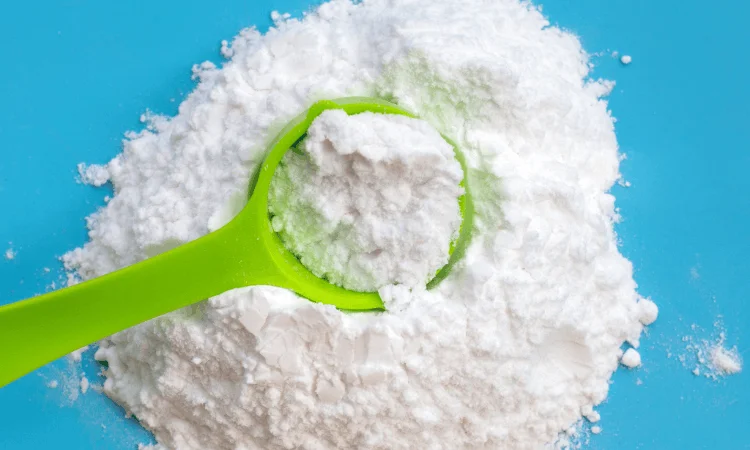
Moisture and dry matter determination in detergents and soaps: The right method for quality control
The feeling of a soap in the hand, the flow behavior of a powder detergent or the viscosity of a liquid cleaner – all these properties have an invisible but decisive parameter: the moisture content. In detergents and soaps, water is both an indispensable component of the formulation and a variable in the manufacturing process that needs to be controlled. Too much moisture leads to clumping in powder products, loss of hardness and microbial degradation in soaps, while too little moisture impairs processability and consumer perception. Therefore, moisture and dry matter determination is a cornerstone of routine quality control in the detergent industry.
Die Trockenmasse repräsentiert die Summe aller wasserfreien Bestandteile des Produkts und wird in der Regel aus dem Feuchtigkeitswert berechnet. Hierbei gibt es jedoch ein entscheidendes Detail: Der gemessene „Feuchtigkeitswert” kann je nach Methode nicht nur Wasser, sondern auch flüchtige organische Verbindungen umfassen. Die Wahl der richtigen Methode ist daher für die Zuverlässigkeit und Interpretierbarkeit der Ergebnisse von entscheidender Bedeutung.
Moisture and dry matter: definitions and relationship
Technically, moisture is the total amount of water and volatiles that can be removed from the product under certain conditions. The dry matter, on the other hand, is the solid residue that remains after the removal of this volatile fraction. The relationship between the two values can be expressed simply:
Dry matter (%) = 100 − moisture (%)
Diese Formel gilt jedoch nur, wenn der gemessene Feuchtigkeitswert tatsächlich nur Wasser repräsentiert. Bei der Ofenmethode werden alle Stoffe erfasst, die bei der Prüftemperatur verdampfen (Alkohole, Lösungsmittel, einige flüchtige Wirkstoffe). Daher kann bei flüssigen Waschmitteln mit hohem Alkohol- oder Lösungsmittelgehalt der „Feuchtigkeitswert” höher ausfallen als der tatsächliche Wassergehalt. Für solche Produkte sollten wasserspezifische Methoden wie die azeotrope Destillation oder die Karl-Fischer-Titration bevorzugt werden.
Decisive factors in the selection of methods
The method of moisture determination in detergents and soaps is selected according to the physical shape of the product, the matrix composition and the purpose of the analysis. Three basic approaches are in the foreground:
1. Furnace method (ISO 672 and ASTM D4574)
This is the most commonly used reference method for soaps and detergents. The sample is dried in an oven set to 103 ± 2 °C until weight is constant and the weight loss is calculated as moisture. ISO 672 establishes the framework for this method in soaps, while ASTM D4574 describes the air oven method for soap products using synthetic detergents.
To note: ASTM D4574 specifically states that products containing sodium silicate or more than 1% glycerol may produce misleading results. For such matrices, alternative methods should be considered.
2. Azeotropic Distillation (ISO 4318)
This is a water-specific method. The sample is heated with a solvent (toluene or xylene) that is immiscible with water; the water forms an azeotropic mixture with the solvent, evaporates and condenses in the cooler. The volume of water collected is measured to determine the content. ISO 4318 specifies that this method is suitable for powder, paste and solution formulations with more than 5% water.
The biggest advantage of this method is that it is not affected by volatile organic compounds and directly provides the amount of water. Especially with solvent- or alcohol-containing liquid detergents, it delivers more reliable results than the oven method.
3. Thermogravimetry (TGA) and Rapid Methods
Thermogravimetric analysis measures the change in weight of a sample under a controlled temperature program. It is significantly faster than the furnace method (in the minute range) and requires only a small amount of sample. However, the TGA is not water-specific either; volatile components are also recorded. It can be used for rapid screening in ongoing production control, but furnace or distillation should be preferred as a reference method.
Comparison of Moisture Determination Methods
The following table summarizes the main features of the methods for moisture and dry matter determination in detergents and soaps:
| Method | Reference standard | Measured parameter | Suitable product types | Limitations |
|---|---|---|---|---|
| Oven Method | ISO 672, ASTM D4574 | Moisture + volatiles | Solid soap, powder detergent | Also detects volatile organics; Misleading for silicate/glycerine-containing products |
| Azeotropic Distillation | ISO 4318 | Water only | Liquid detergents, pastes, powders | Longer duration, special glass equipment required |
| Thermogravimetry (TGA) | — | Moisture + volatiles | All Forms (Rapid Screening) | No reference method, not water-specific |
Interpreting the results: Why dry matter is important
Der Trockenmassewert ist ein praktischer Indikator für die „Wirkstoffdichte” des Produkts. Der Trockenmassegehalt eines Pulverwaschmittels spiegelt die Summe aus Tensiden, Buildern und Füllstoffen in der Formulierung wider. Bei flüssigen Produkten zeigt die Trockenmasse die Konzentration gelöster Feststoffe (Tenside, Salze, Polymere) an.
Moisture control in the production process is also cost control. Excess water increases transport costs and shortens the shelf life of the product. Therefore, manufacturers keep the specification ranges narrow to ensure both quality and efficiency.
Reliable moisture and dry matter determination with nano test
In the detergent industry, quality control starts with the right method and reporting. Nano-Test offers manufacturers of detergents and soaps services for moisture and dry matter determination in GLP-compliant laboratories.
Nano-Test Service Description
Nano-Test performs analyses for moisture and dry matter determination in detergent and soap products according to the ISO 672, ASTM D4574 and ISO 4318 standards. Our scope of services includes:
- Oven Method: Moisture and volatility determination by drying to weight consistency according to ISO 672 and ASTM D4574.
- Azeotropic Distillation: Water-specific distillation method according to ISO 4318 for reliable results.
- Dry matter calculation: Calculation and reporting of dry matter content from moisture data.
- Methodological advice: Choosing the most appropriate method for your product matrix (furnace, distillation, or both).
- Method validation: Development and verification of product-specific processes.
All analyses are delivered as GLP compliance reports with audit trail and data integrity (ALCOA+ principles). The results are reported with a clear indication of the method used and the standard.
Advantages of Nano-Test:
- Dual methodological competence: Both furnace method and azeotropic distillation in the same laboratory.
- Correct choice of method: The most appropriate method for your product matrix is recommended to avoid misleading results.
- Accredited infrastructure: ISO/IEC 17025 accreditation for internationally recognized reports.
- Quick Response: Results for standard moisture analysis within 2-3 business days.
- Wide range of products: Solid soap, liquid soap, powder detergent, liquid detergent and surface cleaner.
The determination of moisture and dry matter in detergents and soaps is a seemingly simple analysis, but if carried out incorrectly, it directly influences product quality and production efficiency. The furnace method provides a practical solution for routine controls, while azeotropic distillation provides more reliable results for volatiles. The method used must always be reported in order to ensure interpretability and comparability of the results.
Nano-Test meets the requirements of detergent and soap manufacturers for moisture and dry matter determination with the right choice of methods, accredited infrastructure and GLP-compliant reporting. Work with Nano-Test to document the quality of your products and optimize your production process.