

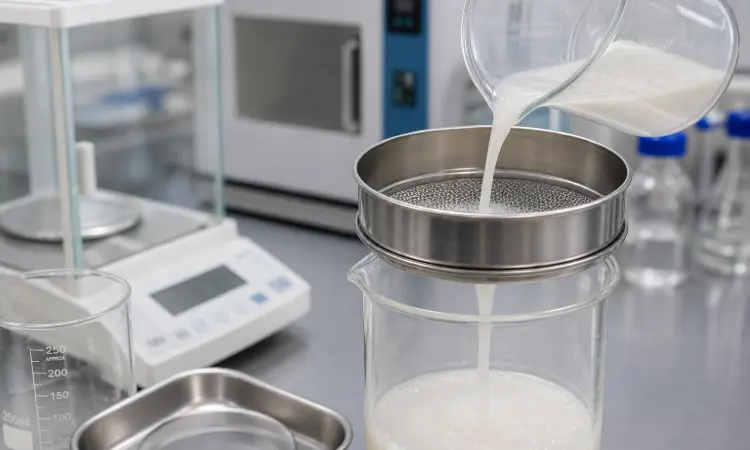
Overview of the CIPAC MT 185.1 Wet Sieve Test
When it comes to plant protection products and biocidal products, the quality of the formulation is not limited to the active ingredient content. How the product behaves in water during application is a key factor in its performance. This is exactly where the CIPAC MT 185.1 wet sieve test comes into play.
This method is designed to measure the product’s dispersibility by determining the amount of particles that do not dissolve or do not disperse sufficiently when mixed with water. This is a critical quality parameter, particularly for water-dispersible powder and granule formulations.
Changes resulting from the revision of MT 185.1
The updates to the CIPAC methodology are intended to make the tests more consistent and easier to compare. With version MT 185.1:
- The two previously separate methods have been consolidated under a single standard
- the procedures were simplified and consistent application was ensured
- In the new specification work, the use of old methods was avoided
This update makes it possible to reliably compare data from different laboratories.
The primary purpose of the test
The wet sieve test simulates the practical performance of a formulation. In particular, the following criteria are evaluated:
- Does the product dissolve evenly in water?
- Are there any large particles or clumps?
- Is there a risk of the application equipment becoming clogged?
The answers to these questions have a direct impact on the product's success in practice.
How does the analysis principle work?
The test is conducted in a very systematic manner. The sample is mixed with water under controlled conditions, and the resulting suspension is passed through a sieve with a specific mesh size. The undissolved portion remaining on the sieve is separated, dried, and weighed.
The result is expressed as a percentage of the total sample. This clearly identifies the proportion of failed dispersion in the formulation.
Wet sieving in accordance with GLP
Good Laboratory Practice (GLP) encompasses not only the conduct of the test but also the assurance of data quality. Conducting the CIPAC MT 185.1 test in accordance with GLP offers the following advantages:
Traceability:Every step is logged and can be reviewed retroactively.
Reproducibility: Tests conducted under the same conditions yield similar results.
Compliance: Weensure that data collection is conducted in accordance with standardsrecognized by international authorities.
This is particularly important in the context of registration and product approval procedures.
Interpretation of the results
The value determined in the test indicates the percentage of particles retained by the sieve. A low value indicates that the product disperses successfully in water.
High values, on the other hand, may indicate the following problems:
- Inadequate wording
- Agglomeration during storage
- Production-related issues
Areas of Application
Areas of Application
The CIPAC MT 185.1 test is used for a wide range of products:
- Pesticide formulations
- Biocidal Products
- Granular and powdered products that are diluted with water
This test plays a crucial role at many stages, from the product development phase through to quality control processes.
Assessment from the industry's perspective
The wet sieve test is used not only to generate laboratory data, but also to predict performance in the field. Products with poor dispersion quality:
- can damage the application equipment
- may interfere with the distribution of the active ingredient
- may reduce the expected biological effect
Therefore, test results are considered a factor that directly influences the product's commercial success.
General Assessment: The CIPAC MT 185.1 wet sieve test has become an indispensable analytical method in modern development processes for pesticides and biocidal products. Thanks to its updated protocol, it delivers more reliable and comparable results. When applied in accordance with GLP principles, it is no longer merely a technical test but has become an internationally recognized tool for quality assurance.
Please contact us with any questions or for further details.
info@nano-test.de