

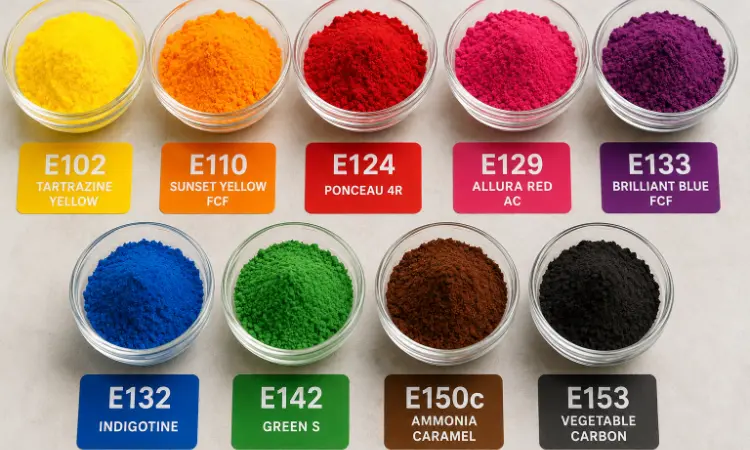
One of the most hotly debated topics in the food industry in recent years remains“food additives.” The flood of information on social media, in particular, is causing consumers to become more wary of additives. But are all additives harmful? Or are they an indispensable part of modern food production?
The terms “clean ingredients,” “clean label,” and “natural additives,” which have gained significance for both manufacturers and consumers today, are accelerating change in the food industry. New-generation additives are no longer used solely to extend shelf life, but also to maintain product quality, enhance sustainability, and meet consumer expectations.
What is a food additive?
Food additives are substances used to extend a product’s shelf life, preserve its taste and aroma, improve its appearance, or prevent microbial spoilage.
Food additives can be divided into many different groups:
- preservatives
- Colorants
- Sweeteners
- Emulsifiers
- Stabilizers
- Antioxidants
- Thickening agent
Additives play a crucial role in ensuring product standardization, particularly in the production of processed foods.
Why are E numbers a topic of discussion?
Among the issues that consumers pay the most attention to are the “E numbers” on product labels. E numbers are a standardized coding system for food additives whose safety has been assessed by the European Union.
For many consumers, however, E numbers can give the impression that these are “chemicals.” But not every ingredient with an E number is harmful. For example:
- E300 → Ascorbic acid (vitamin C)
- E440 → Pectin
- E160a → Beta-carotene
These substances may be of natural origin.
The most important thing is that additives are used in quantities permitted by law and undergo safety testing.
The Rise of the "Clean Label" Trend
In recent years, the “clean label” approach—that is, the concept of clean labeling—has brought about a major shift in the food industry. Consumers now prefer:
- Products with fewer ingredients,
- clearly marked,
- of natural origin,
- preservative-free
For this reason, manufacturers are moving away from synthetic additives and toward natural alternatives. Plant extracts, natural antioxidants, and ingredients derived through fermentation are at the heart of the new generation of additive technologies.
What are next-generation food additives?
Thanks to advances in food technology, safer and more functional additives are now being developed.
Among the outstanding new-generation additives are:
Natural antioxidants: Ingredients such as rosemary extract, green tea extract, and grape seed extract are used to prevent oxidation.
Plant-based dyes: To reduce the use of synthetic dyes, natural pigments derived from beets, spirulina, turmeric, and carrots are preferred.
Fermentation-based preservatives: Lactic acid bacteria and natural fermentation components play an important role in extending shelf life.
Functional stabilizers: Natural emulsions and fiber-based solutions are used, particularly in vegan products, to create consistency and structure.
How is the safety of food additives ensured?
Before an additive can be used, it must undergo comprehensive toxicological evaluations. The European Food Safety Authority (EFSA) and other international organizations:
- the acceptable daily intake (ADI),
- Toxicity,
- Carcinogenicity,
- allergenic effects,
- Long-term safety data
examined in detail.
In addition, regular laboratory analyses and regulatory inspections are of great importance to manufacturers.
How will food additives evolve in the future?
The focus of the food industry in the future is no longer solely on shelf life, but also on sustainability, natural ingredients, and consumer confidence.
In the coming period:
- the reduction of artificial additives,
- the rise of biotechnological solutions,
- the use of naturally derived preservatives
- as well as the growth of "clean label" products
expected.
In particular, growth in the market for vegan, organic, and functional foods is accelerating the transformation of additive technologies.
Conclusion: Food additives are an important part of modern food production. However, as consumer expectations evolve, the industry is increasingly turning to more natural, safer, and more transparent solutions. It is crucial that additives be used in accordance with scientific assessments and in compliance with legal regulations. Regular analyses and quality control processes ensure product safety and protect consumer health.